White Water Rafting With Kids in Costa Rica: Real Age and Weight Limits by River
White water rafting with kids in Costa Rica starts at age 8, and the exact minimum depends on which river you choose. That one fact settles most family debates before they begin. Still, parents rarely ask the question in general terms. They ask about a specific child: a cautious nine-year-old, a fearless six-year-old, a teenager who wants the biggest rapids available. The answer changes for each of them. Below you will find the real minimums we work with on the Balsa, the Sarapiquí, and the Peñas Blancas, taken straight from our own booking rules rather than from a general industry guideline. You will also find what happens when a child gets nervous at the put-in, what our guides do about it, and which option works when your child is still too small to paddle.
At a Glance
- Youngest age for rafting: 8 years old, on the Balsa River (Class II and III).
- Youngest age for the big rapids: 12 years old, on the Sarapiquí (Class III and IV).
- Youngest age on the water at all: 3 years old, on the Peñas Blancas Safari Float (Class I).
- Weight limit: none on any of our river tours.
- Experience needed: none. Every trip opens with a briefing and paddling practice on land.
Can Kids Go White Water Rafting in Costa Rica?
Yes, with conditions. Children can raft the Balsa River from age 8 and the Sarapiquí from age 12. Younger children cannot join a rafting trip at all, though they can ride the Peñas Blancas Safari Float from age 3. Every child also needs to fit the life vest we provide.
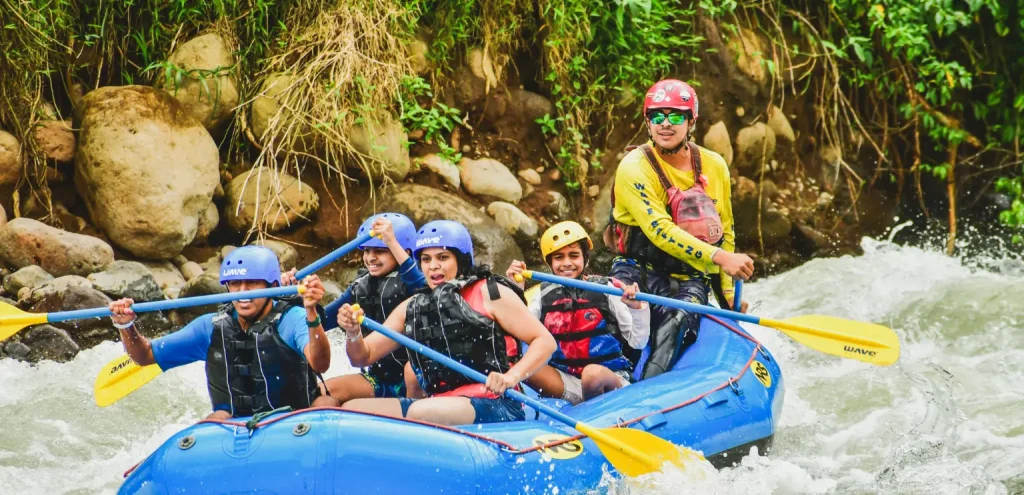
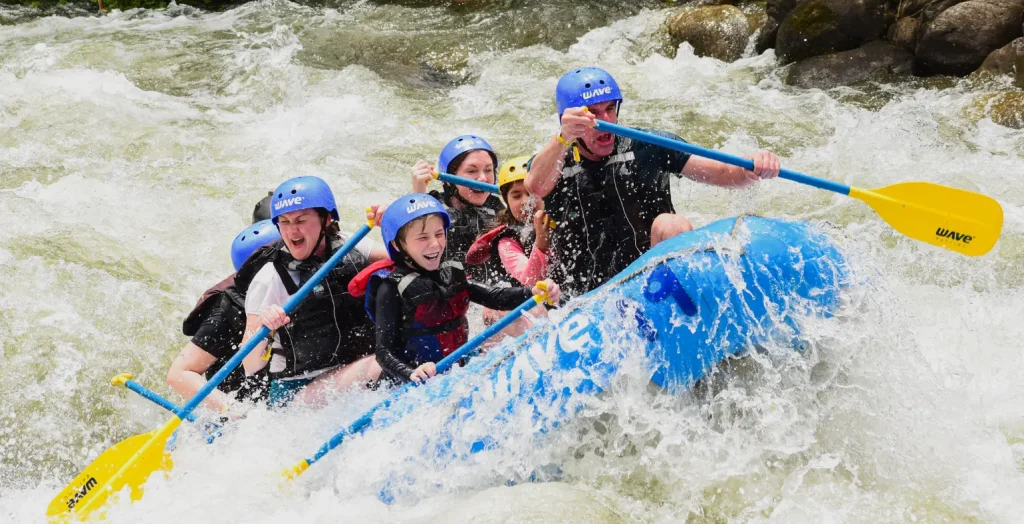
Age is the gate for white water rafting with kids in Costa Rica, and we do not negotiate it. We set it per river because the water behaves differently on each one. The Balsa carries Class II and III rapids, which means medium waves and wide, readable channels that a guided raft handles comfortably. The Sarapiquí adds Class IV sections, where the current is more powerful and a swimmer needs more strength to help themselves. Therefore an 8-year-old belongs on the Balsa and nowhere else in our rafting lineup.
Our booking system enforces this for you. On the Balsa tour, the child rate covers ages 8 to 11 and the adult rate begins at 12. On the Sarapiquí, only the adult category exists, and it also begins at 12. In short, you cannot accidentally book a child onto a river that is wrong for them.
Minimum Age and Weight Limits by River
The Balsa River requires a minimum age of 8. The Sarapiquí requires 12. The Peñas Blancas Safari Float accepts children from 3. None of these tours has a weight limit. Instead, we check one measurement: chest circumference must stay under 56 inches so the life vest closes correctly.
| Detail | Peñas Blancas Safari Float | Balsa River | Sarapiquí River |
| Minimum age | 3 years | 8 years | 12 years |
| River class | Class I | Class II and III | Class III and IV |
| Child rate applies | ages 3 to 11 | ages 8 to 11 | not offered |
| Adult rate applies | 12 and up | 12 and up | 12 and up |
| Time on the water | 1.5 to 2 hours | 1.5 to 2 hours | 1.5 to 2 hours |
| Full tour, door to door | about 3 hours | about 6 hours | about 6 hours |
| Paddling required | no | yes | yes |
| Weight limit | none | none | none |
| Maximum chest for vest | under 56 in | under 56 in | under 56 in |
Notice that weight never appears in that table as a cutoff. For white water rafting with kids in Costa Rica, body weight is not the safety variable most parents assume it is. Vest fit is, and it works as a ceiling rather than a floor. A life jacket has to close around the chest to hold a person high in the water, so we cap chest circumference at 56 inches and leave the scale out of it entirely.
Good to know: children must have already reached the minimum age for their river. Nothing else works as a floor, so there is no minimum height, weight, or size, and a small 8-year-old is just as welcome as a tall one. If you are unsure how your child fits these rules, message us on WhatsApp before booking and we will give you a straight answer.
Which River for Which Age: Balsa, Sarapiquí, or Peñas Blancas
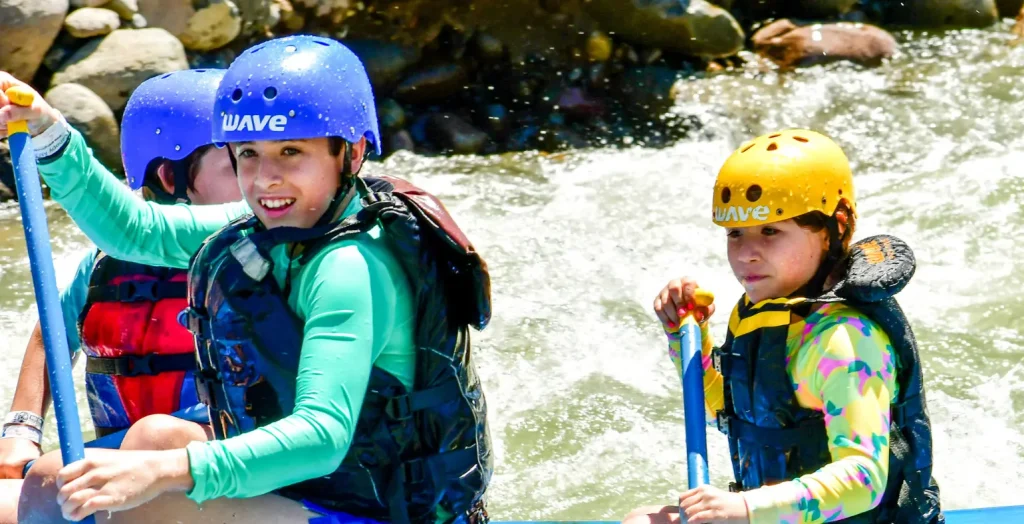
Choose the Balsa for families with children between 8 and roughly 12. Choose the Sarapiquí for teenagers and adults who want real power. Choose the Peñas Blancas Safari Float for toddlers, grandparents, and anyone who would rather watch sloths than paddle through a wave train.
Balsa River: the family run
Our Balsa trip covers 22 rapids in about two hours on the water. Under the international scale used to compare rivers worldwide, Class II means straightforward rapids with wide channels, while Class III brings moderate, irregular waves. Together they produce a ride that splashes hard without ever feeling out of control.
The day has a rhythm that helps younger paddlers. After the first section, we pull over on the riverbank for fresh tropical fruit. The second half then runs calmer, mostly Class II, which gives kids time to look up and spot monkeys, sloths, and toucans. Lunch follows at an organic farm, along with a sugar cane demonstration. Read our full account of the Balsa River rafting experience in La Fortuna for a section-by-section walkthrough.
Sarapiquí River: for teenagers who want more
The Sarapiquí runs Class III and IV, and it opens with roughly an hour of continuous Class IV water. Consequently we set the minimum at 12, and we mean 12 with some appetite for adrenaline. Lunch happens at the Tirimbina reserve, which includes a hanging bridge. Our guide to Sarapiquí river rafting explains what that first section actually feels like.
Quick decision guide
- Traveling with kids aged 8 to 12? Book the Balsa, because the whole family rides together in the same raft.
- Traveling with a teenager who already rafts? Book the Sarapiquí, because Class II water will bore them.
- Anyone in the group under 8? Book the Safari Float, because it keeps everybody on the same boat instead of splitting the family.
What If My Child Is Nervous?
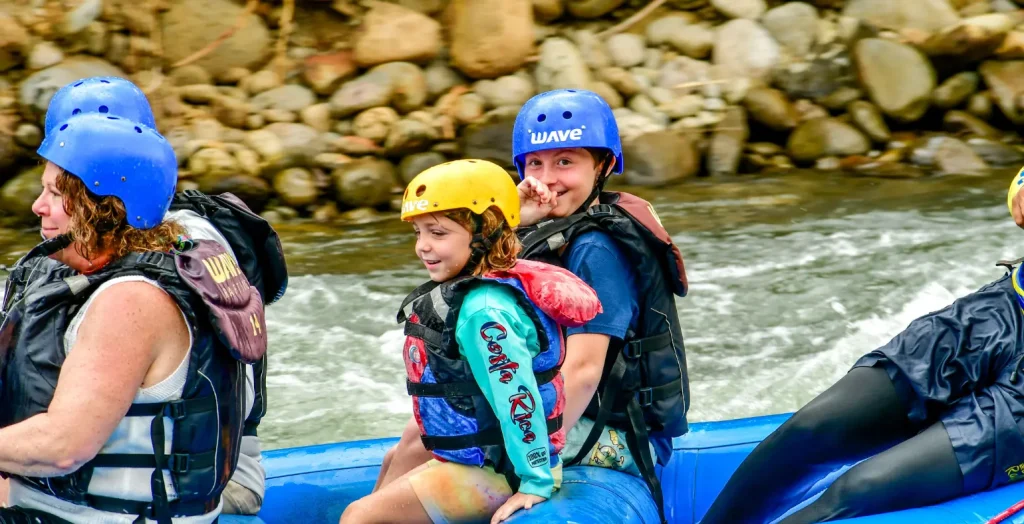
Nerves are normal, and our guides plan for them. Every trip begins on land with a full safety briefing and paddling practice, so children learn the commands before they touch moving water. A safety kayaker then travels alongside the group for the entire run. Nothing on the river arrives without warning.
That land session matters more than parents expect, and it is the part of white water rafting with kids in Costa Rica that changes the day. Children who have practiced “forward paddle” and “get down” on dry ground arrive at the first rapid with a job to do, and a job is a powerful antidote to fear. Guides also seat nervous kids deliberately, closer to an adult they trust.
The Balsa itself helps. Because its flow is partly regulated by hydroelectric dams upstream, water levels stay steadier than on a free-flowing river. The trip also builds in that midway fruit stop, which resets anyone who found the first section intense.
Guests tell this story better than we can:
“First time rafting and I was a little nervous. But the Wave Rafting guides were professional and patient. All the safety gear was in excellent condition, and they explained every step clearly. It was thrilling, but I always felt safe.” Lucas M., Argentina
“This was our first time rafting and we were a bit anxious, but the team at Wave made us feel completely safe. Our guide explained everything so well and made it really fun too.” Sarah D., United States
If your child needs a slower pace, ask us about a private departure. A private raft lets the guide adapt the rhythm to one family rather than to a mixed group.
Safety on White Water Rafting With Kids in Costa Rica: What Actually Happens
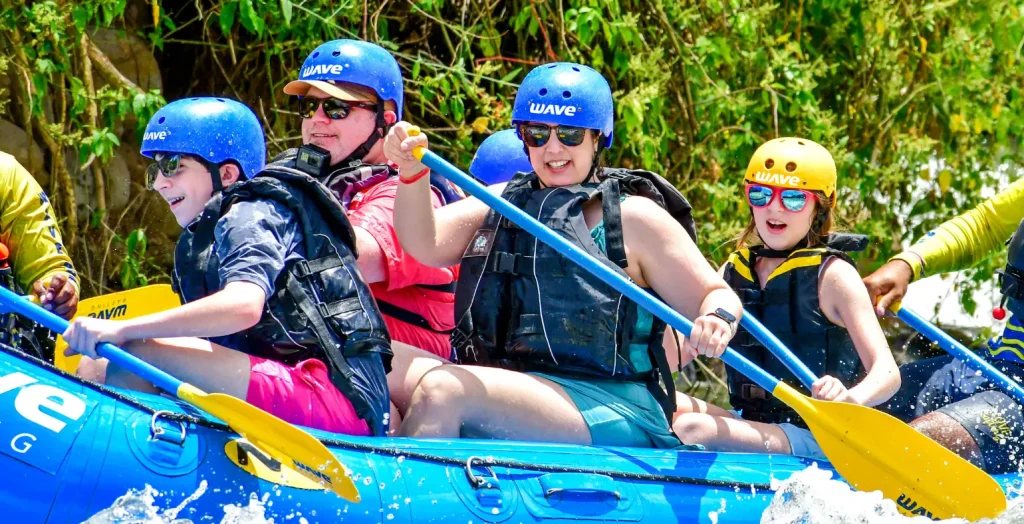
Every guest receives a fitted helmet, a life jacket, and a paddle before boarding. Our guides hold certifications in first aid and swift water rescue. A safety kayaker accompanies each rafting trip. We also monitor river and weather conditions throughout the day, and we postpone or cancel a trip whenever conditions turn unsafe.
The safety kayaker is the part most families have never heard of. This is a separate paddler in a small, agile kayak who works only on safety.
- Scouts ahead. The kayaker reads the water before the rafts reach it and flags obstacles.
- Recovers swimmers. If anyone comes out of a raft, the kayaker reaches them first.
- Retrieves gear. Loose paddles and dropped items get collected without the group stopping.
- Stays in contact. The kayaker communicates constantly with the lead guides throughout the run.
Costa Rica regulates this work. Under the national adventure tourism operating rules administered by the Costa Rican Tourism Board, adventure operators must staff trips with guides certified by the ICT or by a recognized international adventure body. Our fuller answer to the safety question lives in our guide to whether rafting in Costa Rica is safe.
What to Bring for Kids
Packing for white water rafting with kids in Costa Rica is simple: pack light and pack for water. Children need a swimsuit, a t-shirt they can soak, secure shoes, sunscreen, and a full change of dry clothes for the ride home. We supply the helmet, the life jacket, the paddle, and the towels, so leave those at the hotel.
- Secure shoes. Water shoes or sport sandals with a heel strap. Flip-flops come off in the current.
- A t-shirt over the swimsuit. It protects shoulders from sun and from paddle rub.
- Waterproof sunscreen. Apply it before pickup, because the river washes off anything last minute.
- Dry clothes in a bag. Kids get cold faster than adults once the paddling stops.
- Skip the cotton. Wet cotton stays heavy and cold for hours.
- Leave the loose sunglasses. Anything without a strap ends up in the Balsa.
Our complete rafting packing list for Costa Rica covers the rest, and our La Fortuna weather guide explains what to expect month by month.
Too Young for Rafting? Try the Safari Float
If your child is under 8, the Peñas Blancas Safari Float is the answer. It takes children from age 3, runs on calm Class I water, and requires no paddling at all. The boat has no motor, so the loudest sound is usually a howler monkey. The whole outing lasts about three hours, including a short 25-minute drive.
This is not a consolation prize. A naturalist guide points out sloths, toucans, iguanas, caimans, and white-faced capuchins as you drift, and with luck a Jesus Christ lizard sprints across the surface. Afterward we stop at a riverside farm for a traditional Costa Rican snack and fresh coffee.
Families with a wide age range often prefer it precisely because nobody sits it out. Grandparents come. Toddlers come.
Check availability for the Wildlife Safari Float in La Fortuna
Frequently Asked Questions
There is no weight limit on our river rafting tours. There are firm age limits: 8 for the Balsa River, 12 for the Sarapiquí River, and 3 for the Peñas Blancas Safari Float. The one physical requirement is vest fit, and chest circumference needs to stay under 56 inches. There is no minimum weight or size.
The minimum age for Balsa River rafting is 8 years old. The tour runs Class II and III rapids, and the child rate applies from 8 to 11 while the adult rate starts at 12. Children must have already reached 8 to join.
No. A 6-year-old cannot join any white water rafting trip we operate. However, the Peñas Blancas Safari Float accepts children from age 3, so a 6-year-old can still spend a morning on the river spotting wildlife with the rest of the family.
No. Swimming ability is not a requirement on any of our river tours. Every guest wears a fitted life jacket and helmet, the guide explains what to do if you end up in the water during the pre-trip briefing, and a safety kayaker travels with the group for exactly that reason.
Class III rafting is appropriate for children aged 8 and up when a certified guide runs the trip. Class III means moderate, irregular waves rather than steep drops. On the Balsa we pair that with a mandatory briefing, fitted safety gear, and a dedicated safety kayaker for every group.
Rafting the Balsa tops the list for children over 8, and the Safari Float covers everyone younger. Beyond the rivers, families in La Fortuna usually add hanging bridges, a chocolate or tortilla-making workshop, and an easy volcano hike. Most of these pair well with a morning on the water.
No. White water rafting with kids in Costa Rica requires no prior experience on either river. Guides teach the paddling commands on land before anyone boards, and our raft captains steer. First-time families make up a large share of every Balsa departure.
Planning Your Family Rafting Day
White water rafting with kids in Costa Rica comes down to one number: the age of your youngest paddler. At 8 or older, the Balsa gives your family a real Class II and III run with wildlife, a fruit stop, and lunch at a farm. Between 3 and 7, the Safari Float keeps everyone together on calm water. At 12 and up, the Sarapiquí is waiting. When your child sits close to a cutoff, write to us first and we will give you a straight answer rather than a sales pitch.
Book your Balsa River family rafting tour or message our team on WhatsApp with your kids’ ages and we will match you to the right river.