
Things to Do in La Fortuna: The Complete Adventure Guide
Everyone asks about the volcano first. Fair enough. Arenal is hard to ignore when you’re standing at the base of a 1,670-meter cone that used to light up the sky. But here’s the honest version: some days you’ll see it perfectly, and some days the clouds win. Either way, you won’t be bored.
La Fortuna isn’t a one-attraction town. In fact, it’s a small place where most people you meet, the guy who rents you a bike, the woman running the soda down the street, the guide who straps your helmet on before the river, grew up here.
They know this land in a way that doesn’t come from a training manual. Our guides are locals.
For example, they know which bend of the Peñas Blancas the caimanes prefer on a Tuesday morning, and they know when to stop paddling and just listen.
So if you’re figuring out the best things to do in La Fortuna, Costa Rica, stay with us. By the end of this guide you’ll know exactly what’s worth your time, what to combine, and how to book it without second-guessing yourself.

White water rafting on the Balsa & Sarapiquí rivers
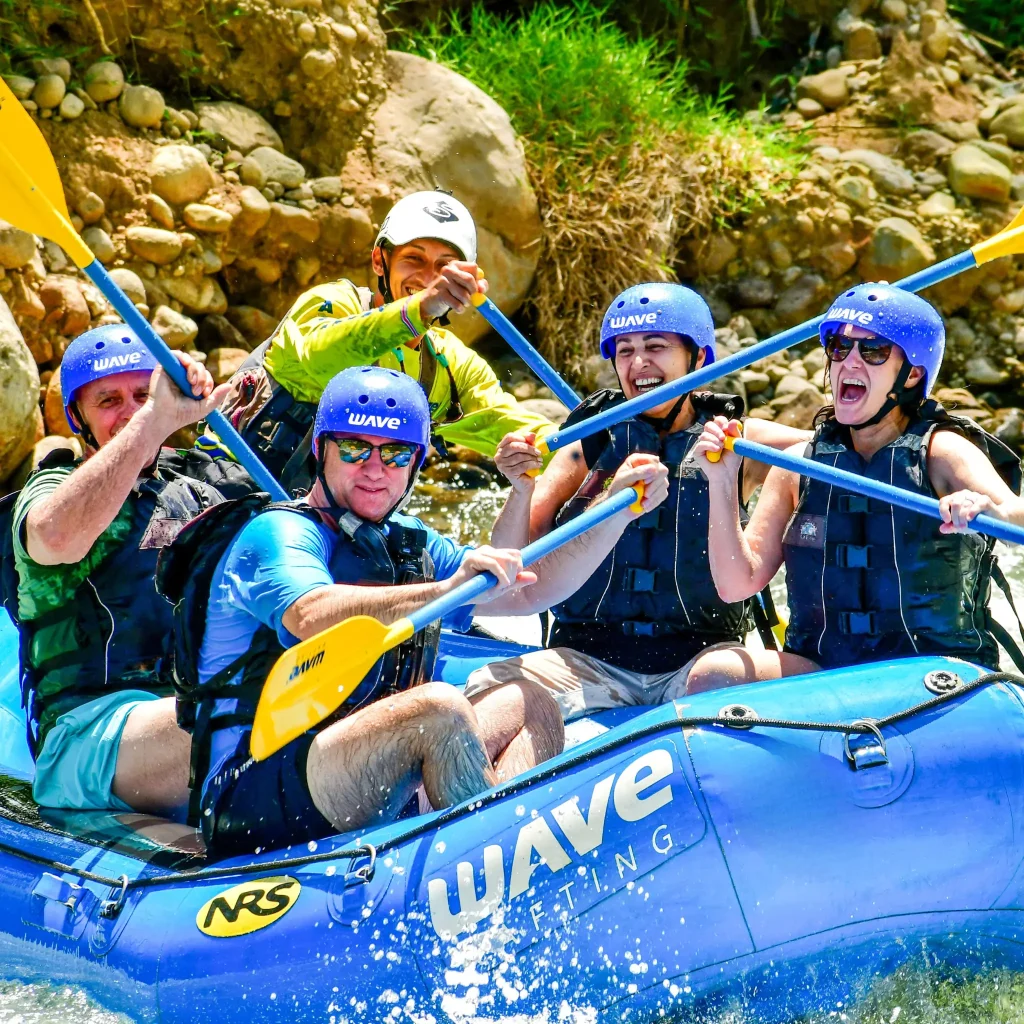
The rivers around La Fortuna are the reason a lot of people end up here in the first place, and the reason many come back. Two rivers, two completely different experiences, both legitimate. Here’s how they break down.
Balsa River: Class II-III, ideal for families and first-timers
The Balsa is where we take families, first-timers, and anyone who wants to actually enjoy the scenery between rapids instead of just surviving them. Class II-III means real whitewater. You’ll work, you’ll get wet, you’ll probably yell, but nobody’s getting a pre-launch safety speech that makes them reconsider their life choices.
Moreover, kids can join from age 6. The canyon sections are lined with heliconias, the toucans are reliably present and reliably show-offy, and the post-trip lunch is included because we believe a good meal is part of the adventure.
On top of that, if you’re coming between May and November, you’re in luck. Rainy season swells the Balsa and the rapids get a proper push. The canyon walls turn an almost unreasonable shade of green.
Sarapiquí River: Class III-IV, for the adrenaline seeker
The Sarapiquí, on the other hand, doesn’t ease you in. Sixteen kilometers of Class III-IV from start to finish, no mellow middle section, no float-and-catch-your-breath stretch. One rapid ends and the next one is already starting. It’s relentless in the best way.
This river cuts through a jungle corridor most tourists never reach. As a result, the guides who run it know every hydraulic, every line, every rock that has a name because someone once met it the wrong way. Minimum age is 12, and showing up reasonably fit helps. Your arms will know they were there.
→ Book your rafting tour with Wave Expeditions

Safari float: wildlife on the Peñas Blancas River
Some of the best moments on a river happen at about two kilometers per hour, in complete silence, with binoculars up. That’s exactly what the Peñas Blancas safari float is about.
The experience is the opposite of rafting. No paddling, no rapids, no adrenaline. Instead, you drift. The river moves through one of the few intact wildlife corridors left in northern Costa Rica, and the animals treat it like a highway. Caimanes on the mudbanks, barely moving. Howler monkeys doing their thing overhead, which is loud and dramatic and worth every second. River otters cutting through the shallows. A great blue heron standing in the shadows like it’s been there for centuries.
We always say: if you only have one morning free and you can’t decide, do the float. In other words, people who expect it to be the relaxing option come back surprised by how much they actually saw.
Furthermore, it works for everyone. Young kids, older travelers, groups where half the people want thrills and the other half don’t. Split the group. Everyone wins.
→ Book the safari float
Arenal Volcano & hanging bridges
Arenal was one of the most active volcanoes in the world for decades. Then, around 2010, it went quiet. Today it’s a massive, perfectly shaped cone sitting at the edge of town, occasionally visible and occasionally not. On a clear morning it stops you mid-sentence. On a cloudy afternoon the rainforest takes over completely. Both versions are worth it.
The Mistico hanging bridges trail puts you inside the forest rather than looking at it from the outside. Six suspension bridges, about 3 kilometers of trail, primary and secondary forest the whole way. Some bridges sit above the river, others put you at eye level with the canopy, which is where most of the action is.
Going with a naturalist guide changes everything. What looks like a wall of green starts making sense. Wave Expeditions runs the hanging bridges tour and the Arenal hike, with local guides who know what they’re actually looking at.
Best time to visit for wildlife spotting
Early. Genuinely, the earlier the better. Between 6:00 and 9:00 AM the birds are active, the light is manageable, and the trail is quiet. By mid-morning, however, the tour groups arrive and the birds go quiet. Additionally, if seeing the volcano is important to you, morning is also your best chance. Clouds typically build from the afternoon onward.
Night walks & wildlife tours
The rainforest at night sounds completely different. The birds stop, and everything else starts. Frogs, insects, the occasional rustling in the leaves that you won’t identify until your guide points a light at it.
A night walk is, in fact, one of the most effective ways to see Costa Rican wildlife. Not because the animals are friendlier after dark, but because they’re simply easier to find. The red-eyed tree frogs, the basilisk lizards, the kinkajous moving through the canopy, the vine snakes sitting absolutely still on a branch at head height. None of this is visible at noon. At night, however, with a guide who knows where to look, you see things that daytime-only travelers miss entirely.
For instance: whip scorpions, glass frogs backlit against a leaf, moths with wingspans that make you genuinely reconsider your relationship with insects.
Additionally, if a sloth is on your list, which it should be, La Fortuna is one of the best places in the country to find one. We wrote a full guide on where to look, which trails have the highest sighting rate, and when to go.
→ Read: Where to see sloths in Costa Rica

Canyoning, ATV tours & combo adventures
Beyond rafting and wildlife, two options consistently come up when guests want to add something different.
Canyoning with Pure Trek puts you on a series of waterfall rappels inside the rainforest, with a guide talking you through every step. It sounds intense, and it is. Nevertheless, it’s built for first-timers. The hardest part is the first step off the ledge.
ATV tours get you into corners of the Arenal area that trails don’t reach. Muddy roads, river crossings, open hillside viewpoints. If you have teenagers who’ve been patiently sitting through wildlife tours, this is their reward.
Finally, the smartest way to structure a La Fortuna day is a combo. Rafting plus hot springs, or rafting plus zipline. Transport included, timing handled, food in the middle.
→ See all combo tours
Ready to explore La Fortuna?
The volcano might be hiding when you arrive. The clouds don’t take requests. Even so, the rivers will be running, the wildlife will be doing what it does, and the guides will be ready.
Wave Expeditions runs every tour in this guide. Our team is local, INA and ICT certified, and has been on these rivers long enough to know them by feel. We love rafting, and we love the look on people’s faces when they realize they do too.
FAQ: planning your La Fortuna adventure
Arenal Volcano put La Fortuna on the map, but the rafting, wildlife, and hot springs are what keep people coming back. It’s about 1.5 hours from San José, close enough to be a natural stop on a longer itinerary, and developed enough to be comfortable. At the same time, it’s still small enough that the person who serves you breakfast probably knows your guide.
Two full days if you’re efficient. Three, however, if you want to actually relax between activities. Most people pair La Fortuna with Monteverde or Manuel Antonio on a 7 to 10 day Costa Rica trip. In that case, arriving Monday or Tuesday and heading out by Thursday works well. You get the best availability and miss the weekend surge.
It’s one of the most activity-dense destinations in Central America, and the quality of operators has gone up significantly in the last decade. Moreover, the guides here are mostly local, people who grew up on these rivers and in these forests, and that makes a real difference in what you actually learn and experience. The volcano may or may not be visible. Everything else will be.
You can hike through old lava fields inside the national park, walk the Mistico hanging bridges on the volcano’s slopes, and soak in geothermally heated hot springs in the evening. For the clearest views of the cone itself, however, go early. Afternoons are reliably cloudy, which is beautiful in its own way but doesn’t help with photos.
Really good. The Balsa River takes kids from age 6, the safari float has no physical demands, and the hanging bridges trail works for most fitness levels. Furthermore, the night walks are the kind of thing kids talk about for months afterward. Hot springs at the end of an active day handle the wind-down naturally. We run family groups all the time. If you’re not sure what combination works for your ages and energy levels, just ask when you book.
Welcome to WordPress. This is your first post. Edit or delete it, then start writing!